
Multimedia library platform

Multimedia library platform
A mobile-accessible platform for collaborative work with diverse library resources.
| Project lead: | Prof. Dr Torsten Fröhlich, Prof. Dr Bernhard Humm |
| Project team: | Timm Heuss, Peter Eierdanz, Florian Schledt, Thorsten Greiner, Tilman Deuschel, Roman von Cieminski, Oguzhan Balandi |
| Duration: | April 2012 to December 2013 |
| Participating institutions: |
The introduction of digital devices and media is transforming the library landscape. In order to meet these fundamentally new challenges, the University Library at TU Darmstadt is planning to create a multimedia library platform. On the one hand, this is intended to integrate the existing IT systems, thereby making them accessible to intelligent search systems. Secondly, it is intended to implement the currently required enhancements for the use of digital media in particular (e.g. e-books or digital periodicals), especially on mobile devices (smartphones, tablet computers). In order to support users from the academic sector in particular, the platform is to include collaborative and process-oriented elements that enable the creation of, for example, virtual courses or virtual working environments.
The multimedia library platform implements these elements on the basis of tried-and-tested, robust architectural concepts, which make it possible to operate it not only in the ULB’s computer centre, but also as a ‘platform/software as a service’ solution in a so-called cloud environment. The combination of subject-specific functionality and technical innovation (semantic search, mobile interfaces with cross-compilers, augmented reality, collaboration, and cloud capability through in-memory technology) makes this solution unique.
To ensure the necessary communication and coordination within the projects, lightweight, agile development methodologies (Scrum/Kanban) were employed, whilst software product lines ensure that a uniform base platform is used.
The ability to run the multimedia library platform in a cloud environment makes the solution attractive even to the smallest libraries, resulting in significant market potential.
As developing a cloud-enabled solution would have represented too significant a proportion of the project, the necessary generic foundation for this is being created as part of a collaborative project (‘Cloud-based Media and Collaboration Platform’). This will also benefit another collaborative project (“Multimedia Exhibition Platform”), in which a multimedia exhibition platform is being developed for the museum sector.
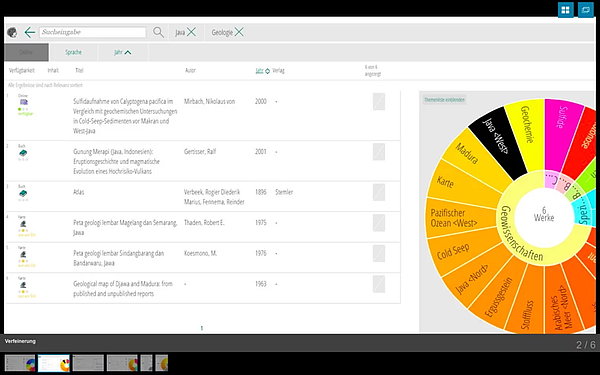
What makes the platform special is that you do not need to know the author or title of a work; instead, you can use the dynamic filtering of the subject area to narrow down your selection to the most relevant results with just two clicks or taps. The dynamic filtering is calculated whilst the platform is in use; it is therefore not manually pre-set, but adapts its content to the context of use.
h_da Research Assistants:
Alexander Ömisch, Tim J. Peters, Ivan Iovine, Theresa Schaub, Dirk Siegmund, Christian Broomfield, Steffen Lohrey and Thomas Köcher